Over the past twenty years, I’ve spent a lot of time thinking about learning. Not just what people learn, but *how* they learn, and perhaps more importantly, what gets in the way. When I started Coracle back in 2006, the goal was simple: no-one should be isolated from learning opportunities. That mission hasn’t changed. But our understanding of what it takes to make learning really work has deepened considerably. I want to share some of the ideas that have shaped our thinking: ideas we’ve tested, argued over, and ultimately built into the way we design and deliver learning experiences.
There’s No Single “Right Way” to Learn
Let’s get the biggest myth out of the way first. There is no single best way to learn. Different people respond to different things, and intelligence itself is far more multifaceted than a simple IQ score suggests. As Howard Gardner argued decades ago, the role of psychology is not to dictate education but to help us understand the conditions in which it takes place. One person’s limitation really can be another person’s opportunity. What we can say is that bite-sized, accessible, flexible learning tends to work well for a diverse audience — particularly adults with jobs, families and competing demands on their time. The explosion in online learning hasn’t made the question of how to learn obsolete; if anything, it has made it more urgent.
Adults Learn Differently — and That Matters
The study of how adults learn, what Malcolm Knowles called andragogy, holds up well in practice. Adults see themselves differently from children. They come with life experience, they’re autonomous, and they want learning that solves real problems they’re facing right now, not abstract knowledge they might need years down the line. This has real implications for how we design access to digital courses. Adults need self-assessment tools that help them identify their own learning gaps. They benefit from case studies, discussion, and the opportunity to bring their own experience to the table. And they need flexibility, the ability to pick and mix content, to dip in and out, to follow a curriculum that matches their current readiness rather than the logic of a textbook. Online learning, done well, is ideally suited to all of this. The key phrase there is *done well*.
Active Beats Passive, Every Time
I’ll admit I’m no gardener. But I’ve always appreciated that a garden left to its own devices will be overrun by weeds. The same is true of learning. Even a passive environment will result in people picking something up, but much of it will be inaccurate, shallow, or quickly forgotten. Active learning, where learners are encouraged to develop ideas, research, reflect, and engage rather than simply receive, consistently outperforms passive approaches. Edgar Dale’s “Cone of Experience” captured this intuition in the 1940s, and while the specific numbers have been disputed, the underlying principle holds: doing and teaching are far more effective than reading or listening alone.

If you design a course that assumes learners will sit passively while knowledge is poured in, you’ll be disappointed. If instead you create an environment that invites curiosity, challenges assumptions, and expects learners to participate, you’ll see real results.
Testing Isn’t Just for Measurement — It’s for Learning
One of the counterintuitive findings we’ve come back to again and again is the value of testing not as a way to measure what people know, but as a way to help them learn in the first place. The research on this is robust. Testing forces retrieval, and retrieval reinforces memory far more effectively than re-reading.
Ebbinghaus mapped our habit of forgetting back in 1885. The antidote isn’t repetition, it’s retrieval. Build plenty of opportunities into your courses for learners to actively recall information, and treat testing as a private, low-stakes activity rather than something that earns certificates or triggers anxiety. The shift from “testing to prove” to “testing to learn” is a small one in design terms, but the impact on retention is significant.
When it comes to formal assessment, multiple-choice questions, when constructed carefully, offer a scalable, reliable and genuinely useful tool. The key is designing questions that require genuine understanding rather than simple recall, with plausible distractors and clear, unambiguous phrasing. Good assessment design is harder than it looks, and too many training programmes skip it entirely.
Reflection Is Underrated
There’s a lot of talk about “flow” (that state of absorbed, effortless engagement with a task). It’s real, and it’s valuable. But there’s a risk that flow becomes an excuse to stay in your comfort zone, tackling only what already matches your skills.
Reflective practice, genuinely thinking about what you got right, what you got wrong, and why, is one of the most powerful tools a learner has. We encourage learners to aim to get a few things wrong. Not out of masochism, but because errors are where the learning happens. Reflect on them. Discuss them with a mentor or peer. Build a new layer on your existing understanding rather than simply confirming what you already know.
There is no-where we see this more powerfully than inside prisons, where the toughest of individuals feel empowered by being allowed to make mistakes, without judgement from peers. But it’s also true that reflection works best when it’s social. Explaining what you think you got wrong to someone else, or teaching back what you’ve understood, consistently reveals gaps in understanding that you didn’t know were there. It also reinforces knowledge in a way that passive review simply doesn’t.
Motivation Is Fragile — and Needs to Be Designed For
Everyone who has ever set out to learn a language knows how this goes. Initial enthusiasm, steady progress, then a wall. Motivation, particularly intrinsic motivation, needs nurturing. The good news is that course design can do a lot of the heavy lifting. Clear objectives, visible benefits, varied content, chunked into manageable pieces. These aren’t just nice-to-haves, they’re essential architecture. Feedback matters enormously: people need to see that they’re making progress. So does fun. A learning experience that feels like play will always outperform one that feels like a chore.
 Csikszentmihalyi’s flow theory tells us to set goals we stand a chance of achieving. Ericsson’s research on deliberate practice tells us that simply turning up isn’t enough — we need to be intentional about what we’re practising and why. Both of these insights are baked into how we think about learning design at Coracle.
Social Learning Is Not Optional
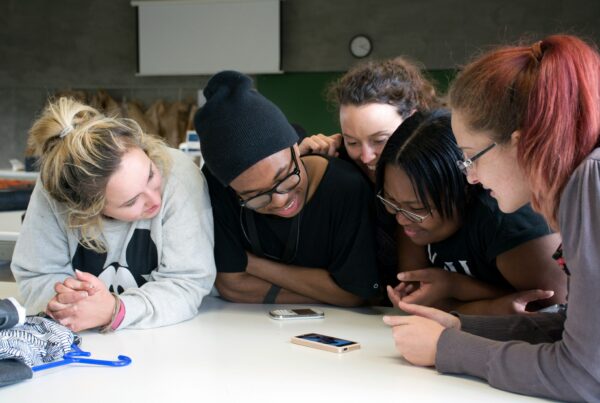
Perhaps the most powerful insight of all is one that we’ve known instinctively for centuries: we learn best from and with other people. The Granny Cloud (British grandmothers who spend an hour a week online encouraging children learning English in remote parts of India) is a beautiful example of what becomes possible when technology removes the barriers of distance.
The web isn’t just a broadcasting medium. It’s a many-to-many network, and that changes everything about the possibilities for peer learning, collaborative study, and community-based knowledge sharing. Colleagues, mentors, fellow learners. These are not supplementary to the learning experience. They are central to it.
At Coracle, we’ve built our platform around this belief: collaboration tools, peer messaging, mentor conversations in context with course content, and a badge system that rewards progress along the way. Learning doesn’t happen in isolation. And given that our mission has always been to reach the most isolated learners, including those in maritime careers, those in prison, those in remote or underserved communities, the social dimension of what we build matters more, not less.
Where We’ve Ended Up
When I look back at the journey from a Christmas conversation in 2005 to where Coracle is today, what strikes me is how consistent the underlying principles have been. We started by wanting to bring learning to people who couldn’t access it. Everything else, the technology, the platform, the pedagogy, has been in service of that goal.
What I’ve learned, building this alongside an extraordinary team over two decades, is that good learning design isn’t complicated in principle, even if it’s hard in practice. Be active, not passive. Test to learn, not just to measure. Make it social. Reflect on what you get wrong. Meet learners where they are, not where you’d like them to be. Keep it human. That’s what we’re building. And we’re just getting started!
James Tweed, Founder & CEO, Coracle Digital